
Hell in a Helmet

I don’t remember the exact date but it was in early 1992 when we were ready to finish school of infantry (SOI) that I received my orders. Up until this point, I had been accustomed to familiar faces and names of individuals with whom I went through boot camp, Marine Combat Training (MCT), and SOI, but as everyone received their orders, it dawned on me that the group of Marines with whom I became friends would no longer be together.

I received orders to report to 2nd Battalion 9th Marines in Camp Mateo–the northern most point within Camp Pendleton neighboring San Clemente. Although I was the only one going to 2/9 from my group of friends, others in our SOI class were also going to 2/9, and stories soon started to circulate.

The 9th Marines lost their colors in Vietnam because they were overrun by the VC and many died. I heard the stories about the 1/9 who earned the title the Walking Dead–they got overrun and had to call arty on their own pos and when it was all over only ten Marines survived, as a side note I got to meet one of the ten survivors later in life. I was never certain how the 9th regiment ended up losing their colors as a whole but they did. The regiment was split up and 2/9 was now a battalion of the 5th Marines.

I soon heard stories that 2/9 was now a battalion made of misfits, troublemakers, and former gang members. 2/9’s budget was never enough and to make matters worse 2/9 gets the left overs scraps that the 5th Marines doesn’t want–that’s the reason 2/9 still had Vietnam era gear. I don’t know if any of that was true but at the time it was quite a story.

I don’t vividly remember reporting into 2/9. The experience is a blur except for wearing my alphas then going over to the barracks. The drive to 2/9 wasn’t far–it was a short drive to Camp Mateo from SOI, one exit south of San Clemente off the 5. I was now a fleet Marine with Echo 2/9 Weapons Platoon machine gun section.

Welcome to the Fleet

I don’t know how long it took after we arrived but I remember seeing Marines running in the barracks hallway and looking for places to hide. I was hanging out with another Marine who told me to follow him and run. We ran to his car where he locked the doors. He told me that they are looking for the Marines new to the fleet and fresh out of SOI to initiate them.

The initiation ritual involved many Marines holding down the new Marine and pulling up their t-shirt while the rest of the platoon (or section) uses the thickest sandals available to repeatedly beat on their stomach. Before they were done, they were covered in hot sauce. He told me that they’ll keep looking for the new Marines until they’re all initiated.

I’m not sure if it was just pragmatism on my part, I certainly wasn’t trying to be brave or make a point, but one thing for sure is that I did not want to keep running for days nor did I feel like hiding. So, I stepped out of the car walked into the barracks and made my way towards the Marines. They had just finished initiating another Marine whose belly was completely red. They looked at me and ran to get me. When they grabbed me I told them to go ahead that I just wanted them to get it over with. They looked disappointed then one of them yelled, “there’s another!” They left me alone. They did eventually catch the Marine who hid in his car.

There were so many initiation rituals. The first time you go to the field was another, and I remember a lieutenant getting initiated in the field. Sometimes though it was just boredom that led to aggressive play–it’s tradition.
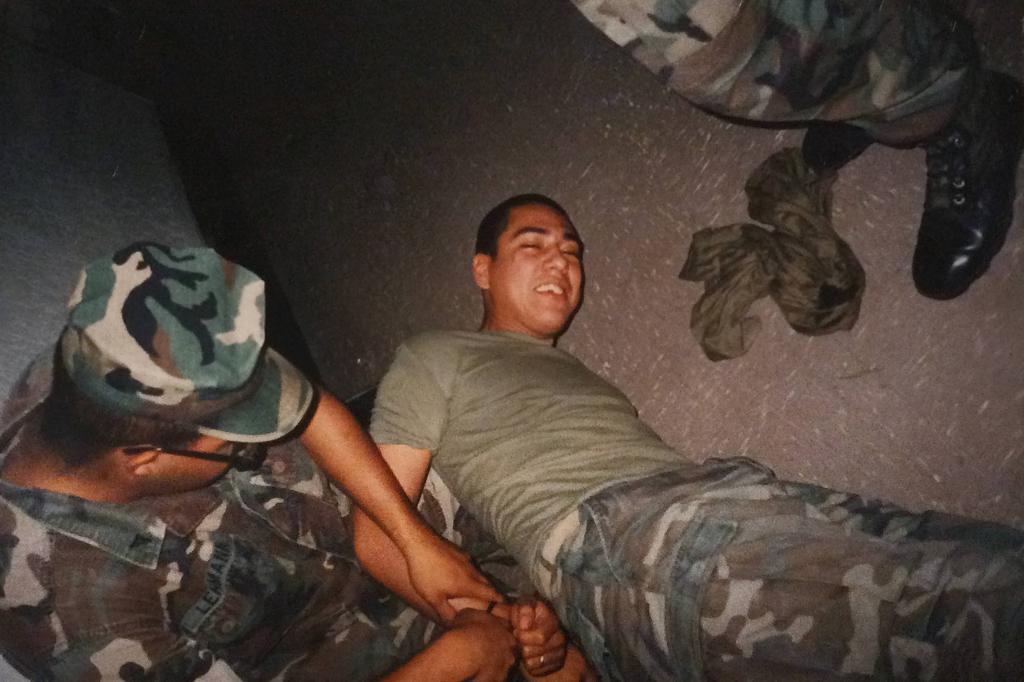
the result of not being aware of my surroundings, alone with another section

Shortly after, a Marine, in another company (I can’t remember if it was Fox or Golf), was initiated and we all heard about it–the Marine’s father was a general and some had to pay. Suddenly there were talks about hazing and how The Corps does not condone that and so on. We could tell the officers were shaken–not by the incident but that a general was involved. The whole thing was a dog and pony, and everything went back to normal after some time.

We put in a lot of field time, a lot of training. I liked being out in the field except when it was cold. I liked running with a team, setting up the machine gun, going on patrols with the 11s. Garrison was fun too especially when we would get bored and look for something to do. There was a lot of wresting, and displays of agrro with usually one section going after another. I was sitting in a room watching TV once when I didn’t realize I was alone in a room full of members of another section that eventually led to me getting hog tied. That led to us trying to capture one of theirs.

Training

We did get some good training. The word we received is that the 5th Marines were not willing or did not have the funds to give to 2/9 for good training so our battalion CO figured out an ingenious way to get us training. We went to Fort Hunter Ligget. He volunteered our battalion to participate in an exercise where the Army was testing out new tank equipment. The Army got a grunt unit to go against and 2/9 well we got a chance to train in the cold mountainous terrain going against tank units–Marine grunts do not use sleeping bags, but we used them that time.

The same thing happened in 29 Palms. The battalion CO sent us there to train. As luck would have it the 5th Marines did not have or couldn’t provide funds so we ate 3/1’s chow. 3/1 didn’t like it much, but we ate. There was a big fight while we were there that Scrappy started, but that is another story.

Looking Back

Looking back on my experience and how the CO adapted to the situation he was handed to ultimately get us training, I took a lot from that. I learned a lot from that. I learned how to look at the objective and figure out how to get there. I learned that there are many ways to accomplish what you need to accomplish. Those lessons have served me well from impetuously moving to Sacramento the day after I got out of The Corps without a job, without housing, and without family to moving to Argentina knowing that I was embarrassed of my Spanish when I first got there, and not knowing anyone when I got there.

I no longer believe the stories that the battalion was made up of misfits and troublemakers. How could it be? I was in it and so were many of the Marines who became my friends: Pangan, Huang, Ponyboy, Scrappy, Bunny, Dorscher…


Fear Makes The Wolf Look Bigger

I found this picture on the Internet. I tried to find the original location and name of the person who took it to give credit without any luck. Beyond the graphics this has a power statement based on a German proverb.

What a true statement! A pause for reflection about what could have been, what I may have missed out on if it wasn’t for fear. At the same time though, an opportunity to reflect on the opportunities when I took a deep breath an carried on or took a step in a different trajectory.

My family and I are working through a relocation. This isn’t out first relocation, but it is the first one during a pandemic where my wife and kids are in one state while I am in another with stay-at-home orders and travel restrictions. The situation is stressful, yet manageable.

We are moving to California, leaving Texas. Texas grew on me and I learned to love it–my favorite city is Dallas and the surrounding area. I have a comfortable life in San Antonio, great friends, great neighborhood, but I was looking for that next challenge and opportunity. I was lucky to find that opportunity in California with a phenomenal company where I am surrounded by brilliant peers, coworkers, and leaders–subject matter experts in our industry.

We pulled off our relocation to San Antonio from Dallas in two weeks. Just like now, we had some trepidation about the move. We didn’t know anyone in San Antonio; we were pulling the kids out of school again; we pulled our son when he was starting his senior year; and I took a role with a smaller company–ISS. My colleagues questioned my motives. Why leave CW when I have it so good, when I made a name for myself? Why leave to a company like ISS who doesn’t have a good reputation in the US? Did I not hear of all the trouble the company has? Did I hear the CEO and COO were fired?

All valid points, but as I stood firm with my decision, I thought of the opportunity to contribute to a new organization. Sheryl Sandberg’s word in Lean In. How she left Google for opportunity for a smaller company–Facebook. I took a deep breath and carried on.

When I arrived at ISS, I stopped in middle of the street and questioned whether I made a mistake. I traded my office on the 10th floor in a class A building in Dallas for an office of what used to be a mechanic’s shop with the roll up gate serving as a wall behind my back. I inherited an operation with high turnover, low morale, old technology, and a P&L in the red. There was no turning back.

One of the first challenges I took on was the high turnover. The high rate was affecting morale, service delivery, and the customer experience. The turnover was so high the operation consisted mainly of temp labor. There was no consistency in service and customers were upset. I performed a market wage analysis and discovered that we were paying minimum wage, we were below market, and below our competitors. I understood why we could not attract nor keep employees.

In addition to starting new training and onboarding programs, I decided to give my team a wage increase to be competitive. My team expressed their worry. How could I justify giving a wage increase when the operation was losing money? I informed them of my findings and that I was taking a calculated risk that by increasing wages we would attract and retain employees. If successful we would eliminate the temp labor that came with a 35% markup. They were not convinced but followed my directive.

We had just relocated to San Antonio, I went home and told my wife not to fully unpack. I told her what I was doing at work and told her that we are if I still had a job at the end of the quarter.

Thankfully my gamble paid off and turnover reduced to industry standard with the added benefit of eliminating the temp labor markup that went back to my profit margin. We were on our way!

There were many deep breaths in my life. When I relocated to Argentina, I stopped in my tracks when I landed in Ezeiza–the sounds, smells, and signs hit me. I realized I was not in the US. I was in a different culture, with a language that I used only occasionally. When Scrappy and I were in the helo, locked and loaded, looking out the window before we landed–I could have frozen.

Fear makes the wolf look bigger.

Don’t act like a Marine

“Don’t act like a Marine.”  I am paraphrasing the best piece of advice I received by my then boss, and mentor Jon Oka.

How Marines Grunts Perceived

Bossy, loud, obnoxious, and lacking emotion.  Speaking about veterans in general, “they’re seen as doers, people who can sort of take action and get things done, but the consequences of that is people see them as sort of less feeling, having less emotion,” said Dr. Steven Shepherd, a marketing professor at Oklahoma State University speaking to Richard Sisk writing for Military.com.

Here are a some more stereotypes I have heard regarding the military in general:

  • they can lead when their direct reports are obligated to do so but leading in the civilian world is not the same as leading in the military.
  • Prior service members do not know how to take initiative.
  • The military makes robots

A year after getting out of the Marine Corps, I started working for Jon leading a team tasked with replenishment, reverse logistics, inventory control, inventory maintenance, and customer service.  I did a good job monitoring metrics and making sure that we met them and take corrective action when possible deviation was detected.

I was focused on the mission and like a good Marine I took care of my team—making sure they had what they needed to get the job done.  All lessons I learned from the Corps.  I also picked up the habit of being direct, to the point, and assertive.  The truth is I fit the stereotype of a Unites States Marine grunt.

In the fleet, grunts follow orders—swift, immediate obedience to orders.  What is a grunt?  A grunt is the infantryman whether in the Army or the Corps.  Grunts are the ground stompers at the frontline everyone else is support.  There is room for initiative, swift thinking, and on the go decision-making necessary for successful small unit tactics that is another story.

I was good at barking orders and making sure they were followed.  One day Jon approached me and had a one-on-one with me. He told me that I was good at organizing, planning, and controlling, but that was not enough.  He gave me some advice.  He said that if I wanted to be a leader higher up in the chain of command that I would have to develop soft skills especially the ability to use diplomacy and navigate corporate politics.  He said that without that skill I would be successful, but that he did not see me leaving the supervisory or frontline management ranks.  Act less like a Marine

Fast forward to 2015, I was in my office when the Director of HR walked into my office and said that heard that I was a veteran.  When I responded that I was, he said that I must have been in the Air Force.  I responded that I served in the Marine Corps.  He returned that I must have been an officer to which I replied that I was enlisted.  He then said I must have worked supply.  I replied that I was an infantryman.  He then stated that I must never have been sent anywhere were someone was shooting at me to which I replied that I had.  He shook his head in disbelief.  The point I did not fit his notion (stereotype) of a Marine.

I have read some posts refuting the stereotypes.  My interactions with sailors, airmen, and some soldiers in San Antonio have taught me that in fact that stereotype does not hold true—the caveat to all servicemembers.  I have interacted with Marine Corps and Army grunts for whom the stereotype of lacking tact and IE/EQ holds true—I was one of them.

Of course, this advice is geared toward those already employed.  My intent in this post is not to address the obstacles in gaining employment of which there are many articles already written.  I will write about some traits inherent in Marine Corps’ grunts.

Marines run toward the sound of chaos

I cannot count how many times I have heard the saying Marines run toward the sound of chaos/Marines round toward the sound of gunfire.  Well, in my case both are true, the latter in a literal sense as rounds were aimed at us, and I have run toward chaos ever since leaving active duty.

I have made my career running toward organizations whose divisions or business units are in distress, running at financial loss, or have toxic cultures that need to me addressed.  Where others may have run away and preferred a turnkey operation with opportunities for nominal improvement, I have thrived while keeping a cool head, and bringing up morale.  I have been called the fix it guy more than once. 

My wife once told me something shocking.  She called me the fix it guy then added that what makes me different is that while other fix it guys are known for coming in and firing staff, I go in work with existing teams, develop them, and via influence get their buy in for my vision of how the operation will run.

Small Unit Tactics

Isn’t that what Marine squads do?  We cannot choose who is assigned to our squads.  We must train our teams to eliminate deficiencies and perform at optimal efficiency—all those gun drills. Marines sharpen their skills and develop teams.  The belief that Marines follow orders and cannot think for themselves is a fallacy.

Marines have been operating in small units with independence and autonomy since November 10, 1775.  They operate in small units with a high probability of injury or death, (my MOS had a 6 to 10 second life expectancy) someone always must be ready to step in, to think on their feet as the situation unfolds.  We were able to make decisions as long as the mission objectives were met.

I have plenty of examples where I made the call for high risk decisions that others before me were scared to make.  One example that comes to mind is when I took over an operation that was losing money.  After analyzing the situation, I made the call to give the staff a 16% wage increase.  The operation was paying below market rate and was experiencing high turnover.  Because of the high turnover, labor was being supplemented via a temp agency at a cost of a 35% markup.   I took a calculated risk that increasing wages would reduce turnover thus eliminating the need for temp labor.

The leadership team that reported to me said it was a crazy idea.  How can I increase cost when we’re already losing money?  My tactic worked, and I was able to return an annual 84K USD back to my P&L that would have been margin paid to temp agencies.  My mission was to get the operation back into the profitability.

Mission Focused

Leading teams during difficult times requires focus, determination, tenacity, and the ability to navigate ambiguity. This is the case in business as it is in a combat environment.  In both situations, the rules of engagement are not clear and/or are constantly changing. Irrespective of what difficulties pop up, situational awareness is necessary in order to navigate through and around obstacles while reaching mission objectives.

My Advice to Marine grunts is learn the soft skills, learn about emotional intelligence, and get a mentor.  Be proud of being a Marine, act like a Marine—adapt and lead.

Blog at WordPress.com.

Up ↑