Throughout bootcamp, pride, espirit de corps, and love of The Corps were ingrained into us in bootcamp. Always faithful to God, Country, and Corps. Once a Marine always a Marine; as long as the Corps lives on you live on. Really, we are immortals among mere men!
I went to a MilCity event here in San Antonio where someone I met encouraged me to put in a claim for my hearing loss. She said I deserved it for my service tot he country and acknowledged that Marines seem to be the hardest to convince when it comes to documenting ailments and injuries while on active duty and definitely once in civilian life.
By happenstance, I met a medical professional whose job while in the military was to review medical records of transitioning service members. When she found out I was a Marine, she told me of how many times she discovered that Marines who were wounded but there was nothing in their records. She said there was a Marine she helped who had a broken leg yet no record of it. She said Marines are a different breed. My objective is not to brag about how tough Marines are–truly.
At the start of the summer, the name of a Marine popped into my mind. I sent him a text asking how he was doing, and I received a reply that he was alive–an innocuous that I did not think twice of.
After getting out of the Marine Corps, he went to college and earned two bachelors degrees. He is a professional who relocated a couple of times, and was doing really well–staying in touch with friends and former Marines; doing well in his career.
Weeks passed and I sent several text without any reply. I thought he must be busy traveling the way he always does in the summer. We’ve kept in touch all these years so I knew that he spends his summer traveling across the country visiting other veterans with whom we served. He attends every reunion event. Eventually I received a group text from him.
“he shot himself in the stomach and heart”
The text apologized for not replying to everyone on the group. He went on to state that the day before I texted him, he shot himself in the stomach and heart–the bullet missed his heart. The text message I received from him telling me he was alive had a whole new meaning.
Here is one of the toughest Marines I have ever known, telling us he couldn’t take it anymore. Luckily he was found and transported to the hospital. He was unable to contact anyone after the incident because he was receiving treatment at a VA hospital, and after being released he has been in a VA therapy group.
I remember he once suffered a broken jaw and had to have his mouth wired shut and placed on a liquid diet; he was hit by shrapnel in another incident, he is one of the toughest Marines I know, a Black Boot Marine, an Immortal.
As long as the Corps lives on, we live on, but don’t go early.
The article goes on to mention the suicide rates among veterans, and some risk factor–isolation, previous suicidal thoughts, and access to firearms. My friend is single, the fun bachelor with this trusty and faithful companion–his dog.
I suppose the warning signs were there; his dog just died, and I did not see him travelling this summer the way he always does. The good thing is he survived and is getting help at the VA. The point of my story is that you just never know–I didn’t know.
While working on the backyard, I listened to this episode of HBR Ideacast podcast, “The Surprising Benefits of Sponsoring Others at Work,” and it had me thinking of the different individuals who I have mentored and most importantly sponsor at work. I previously read an article about the benefits of mentoring someone that to summarize stated that mentoring someone can help the mentor see different perspectives and offers opportunities to learn too (there are many out there and I cannot find the original one I read).
I make it a practice to mentor and coach others wherever I have worked, and sponsor some of them. One person stands out is Jennifer. I met Jennifer at the start of a new leadership role with a new organization. I make a point of meeting members on my team, and when I get the chance I ask them what they would change if they could.
At this point, I am going to digress a bit. I was recruited for the role because the operation was made up of employees from an acquisition that took place 9 years before. The operation was resistant to chance and was not aligned to the company’s mission and vision. The operation and its leaders still referred to themselves by the acquired company’s name and kept notepads, pens, and equipment labeled with the old name.
They wanted things to remain the same and wanted someone to protect them from corporate intrusion and their attempts to move them in the direction of company.
Jennifer had been in the operation for two years, and transferred there from the corporate office. She was genuinely looking for an opportunity to gain some operational experience in hopes of developing her professional career. She was seen as an outsider by the rest of the team, and relegated to someone that did not have enough experience nor knowledge to advance.
Jennifer was honest and expressed how she wanted the operation to resemble how the company looked in marketing material, social media, and the company’s website. I told her that I would do my best. In talking to her, I discovered that she transferred from the procurement department, and that she also was an accountant and a school teacher in the past. Oh, and she was a TCU graduate.
She’s Not the One!
Some time had passed and an opportunity for an account manager role managing a large regional account became open. I asked Jennifer’s immediate supervisor (the Director of Operations) what she thought about Jennifer for the role–it would have been a promotion. The response surprised me! The Director of Operations mentioned that she was not the right person for the role–that she lacked experience and know how and that up until this point she had only managed a portfolio made up of small local accounts. She offered the name of one of Jennifer’s peers as someone she thought was perfect for the role.
I thought about the person for a second, then replied that I disagreed. I mentioned that although her recommendation was a hard worker, dedicated, and the customers loved him, he did not have the P&L knowledge and did not seem to show interest in learning the skill during our training sessions. Additionally, he did not know MS Excel, and usually needed someone to resolve conflict. I told her that I disagreed with her and that I was going to approach Jennifer about the role.
I was surprised to find out that Jennifer did not believe herself qualified to take on the role. I actually had to convince her that she was a perfect candidate. I told her that she had ops experience to manage the day-to-day; her accounting experience translated to P&L knowledge; her procurement experience would allow her to read the contract and determine the deliverables, and negotiate with vendors and the client; her teaching background would help her coach and develop her team. I told her that the best part would build her team and make sure it matched what she saw on social media, marketing material, and company website. Jennifer was convinced and accepted the role.
She reiterated how she lacked experience...I made a mistake
I informed the Director of Operations and immediately she began telling me how I made the wrong choice. She reiterated how she lacked experience, and underscored how I made a mistake. News got around before I made the formal announcement, and the Office Manager met with me in order to echo the Director’s concerns. She too emphasized how I made a terrible mistake and that it was going to have a negative impact on the client relationship, service delivery, and morale as a whole.
Professional Development
Jennifer took helm of the account and immediately started to have an impact. I’d like to say that I guided her throughout the whole process, but the reality is that she was a natural. Jennifer came to me with situations for which she used me as a sounding board, but her ideas and direction were sound and I agreed with most. She was a natural, like I said–when I say natural I really mean that her combination of experience, knowledge, and education prepared her for this. She just needed some encouragement.
During this time frame, I offered and encouraged my leadership team to sign up for an Emerging Leaders Series course offered by the San Antonio Chapter of Prospanica (formerly the National Society for Hispanic MBAs). Jennifer was the only one to sign up.
I invited my team to attend a Texas LEAD event in Austin hosted by the Austin Chapter of Prospanica. This is a one day event of professional development with distinguished key note speakers and presenters. Jennifer was the only one to sign up.
Credit Where Credit is Due
I should have prefaced that the account Jennifer took over was running at a loss–taking a 12% loss at the close of the fiscal year. I in turn took over the whole operation also taking a loss so turning around this large account was an important part of my strategic plan for the operation.
The account started to generate a profit under Jennifer’s direction and finished the fiscal year with a 12% margin. That’s a 24 point swing! My other initiatives were having positive impact too and the operation closed the fiscal year with a positive margin for the first time in a couple of years.
Jennifer taking over the account, allowed me to focus on the bigger picture. I truly believe that had it not been for Jennifer stepping in to tackle the account I would have been too involved in the account to effectively navigate and transform the whole operation. I was congratulated for the turnaround for which I in turn mentioned that it was a team effort and that Jennifer along with others helped me achieve my goals.
Reputation
Jennifer has since developed into a confident leader who gains loyalty and trust from her team. She now sits on two nonprofit boards, and has received two professional credentials. Additionally, she volunteers for roles within company projects–in reality she agrees to those roles after I tell her that I threw her hat in the ring when speaking to other senior leaders.
I was speaking with someone from corporate yesterday, and when I mentioned Jennifer’s name they mentioned how well liked she is at corporate. I am very proud of Jennifer and I am genuinely excited for her professional future.
I started Marine Corps boot camp at 18 years of age on October 9, 1991. In 1992, after graduating from USMC boot camp, Marine Combat Training (MCT), and School of Infantry (SOI), I reported to the fleet at Echo Company, Weapons Platoon, 2nd Battalion 9th Marines (2/9) as a machine gunner.
Before reporting in, I was told stories about the 9th Marines–that the unit lost its colors in Vietnam and as a consequence the regiment was split up never to exist as a regiment again (now that I’ve been out I’m not sure of this but those are the stories told). The battalions, that previously made up the 9th Marine Regiment, were reassigned to different regiments. 2/9, now part of the 5th Marine regiment or better yet the bastard battalion of the 5th Marines, received all the hand me downs and left over budget scraps of the other 5th Marine battalions–to make things worse we used equipment that the U.S. Army discarded. I’m sure most grunt units in The Corps were in the same situation of working with Army discards, but to have the scraps of scraps was horrible, and extremely demotivating if it wasn’t for the battalion leadership who made the best of it.
Credit to our leaders. We had resourceful leaders who thought outside the box to get us training and resources. The battalion commander volunteered the battalion to be used as the opposing enemy for the U.S. Army when the Army tested new weapon systems at Fort Hunter Liggett–there we learned to deal with oncoming tanks with high tech infrared and heat seeking tech. 2/9 practiced antitank maneuvers and tactics. One thing about Hunter Liggett that I remember is how cold it is. Typically, we grunts go light and freeze at night, but not here. We packed sleeping bags and used them for one of the first times. We slept with boots in our bags, and canteens between our legs so that we would have water that didn’t freeze in the morning.
We went to 29 palms and word soon got around that our unit did not have funds for chow so 2/9 went to chow with 3/1, who did not like us taking their chow. I know the events of the training are not in order, but helps to illustrate why we had old Vietnam era equipment when we trained.
I heard another rumor after getting my orders to 2/9–that the unit was made up of Marines with questionable backgrounds–former gang members, prior prison records, etc. Yeah, it didn’t scare me I just found it odd–I mean how would they know, really.
Scrappy
I met some great people, some with whom I still stay on touch today. I was 17 when I enlisted and convinced my parents to let me go and 18 when I finally went off to boot camp. We were a young bunch for sure and our NCOs were not much older maybe around 21 years of age’–21 or 22 when they reenlisted.
Scrappy was a mortarman with Echo 2/9. I don’t remember when I met Roland “Scrappy” Ocampo. Scrappy stands at a confident 5′ 6″, with his chest sticking out. He was born in Bolivia and grew up in Minnesota, Missouri, Miami, and California (Camp Pendleton)–I am sure there are more cities and states that I am missing. His father was an executive with a large multinational so he moved around a lot.
I gave him his nickname, but it wasn’t before going to Somalia because it took some time for me to get to know him, and spend time with him. So, I’ll digress a bit to discuss his nickname. As I mentioned before, he was only about 5’6″ what I haven’t mentioned yet is that he has a temper.
While on Fort Sherman, Panama he started a fight with the Army that ended up with the rest of the platoon getting involved to help him. At Fort Hunter Liggett, he started a fight with some soldiers and there too the platoon came to his aid. The one I most vividly remember is the one at 29 palms. He started a fight with Marines from 3/1. I remember that LCPL Huang and I came back hurt and we were so mad at him.
So he got his nickname because he reminded me of Scrappy, Scooby Doo’s younger, smaller cousin who was always getting in trouble and always had his fists up wanting to fight. That was Roland, he was Scrappy.
The most memorable Scrappy event took place over a weekend when he and other Marines went to TJ. After partying in TJ, he was walking in San Diego. He was approaching a group of gang members talking while standing on the sidewalk. I think most normal people would say excuse me and make their way through (manners) or go around them, but not Scrappy. Scrappy decided that he was going to walk right past them by pushing and shoving them out of the way. His reasoning was that they should take up all the sidewalk. Well, that didn’t go well for him. An argument and a fight took place. Scrappy was outnumbered and did not fair well. I went to visit him at the hospital in Coronado and I did not recognize him. He was swollen, black and blue, and his jaw was wired shut–he had to eat through a straw.
The general consensus is that Scrappy was an old man (22 years old) who didn’t care for garrison, decorum, and tradition. I can’t count how many times we fell out to formation and he would show up in wrinkled cammies and dull boots. Honestly, I could not understand how the mortar section put up with him. He was unsat. I’m trying not to say that we thought he was a shit bird. Scrappy was quick to point out that he was a field Marine and that the wrinkles in his cammies didn’t matter because he was great in the field–the field Marine. Well, I didn’t like him–he questioned everything. One time he took an unapproved trip to Bolivia and made it to formation just in the nick of time–those of us who knew he went did not think he would be back in time and thought this was truly the stunt that would finally get him in real trouble.
USS Tripoli
Postcard from the USS Tripoli
1992, we were on the USS Tripoli on a Westpac. The USS Tripoli was something else and staying true to 2/9 being a bastard battalion with hand-me-down equipment the same was true for the USS Tripoli–well at least for Echo Company. Echo Company was aboard the USS Tripoli a landing pad helo (LPH), Fox and Golf companies were on the USS Juneau, and the USS Rushmore. The three ships were part of the 15th MEU (SOC). I did some brief training on the other ships that consisted of fast roping and ship boarding and takeover. The Juneau and Rushmore were nice ships compared to what we had at the Tripoli.
The Tripoli was hit a mine in the 1st Gulf War and there were many times where the ship just lost power in the middle of the ocean. The Juneau and Rushmore circled the Tripoli when this happened while we inside sat in the dark, hot, humid ship waiting for the Navy to make repairs get us underway. So when we hit libo, we were happy to get off that ship. The thing is the ship was old, but we also contributed to some of the damage within the berthing areas. Marines get bored, and Marines start to fight just to have something to do so that berthing area took some good hits.
Steak and Lobster
It must have been sometime in November of ’92 when we left Singapore and on our next stop was Australia. We were exited because we heard about how much Australian women truly love Marines–we were 18 and 19 year olds so whether true or not we believed it and given the treatment we received at other libo stops if it was the same, yeah we wanted to go to Australia. Well on our way there we were notified that President Bush was sending us to Bosnia or Somalia.
I didn’t know anything about either nor what was happening at either country. We started having formations where we found out we were going to Somalia. Honestly for me it was a relief because I found out how cold it gets in Bosnia and I did not want to deal with the cold. By this time live ammo, grenades, MREs, and other gear was issued. We got our chocolate chip cammies issued. However we didn’t get any desert boots. We asked and finally heard that the 5th Marine regiment didn’t fund any for 2/9. So we were going into the horn of Africa in black boots?!
We also wrote our goodbye letters–letters that we wrote home in case we didn’t make it back and kept in our left breast pocket of our cammies so that if we died someone can retrieve and send home to our loved ones. I don’t remember what I wrote and to whom I sent it, but I’m guessing it was for my mom.
The evening before we went in we had some good chow. The navy prepared steak and lobster for us. This was the first time I had either. I’ve had carne asada growing up and never had lobster, but there was something fancy about having steak paired with lobster! Where did this come from and why didn’t we have this before? That’s when it hit us that we’re being given a great meal in case this was our last meal. Okay, but that lobster was good.
Into Mogadishu
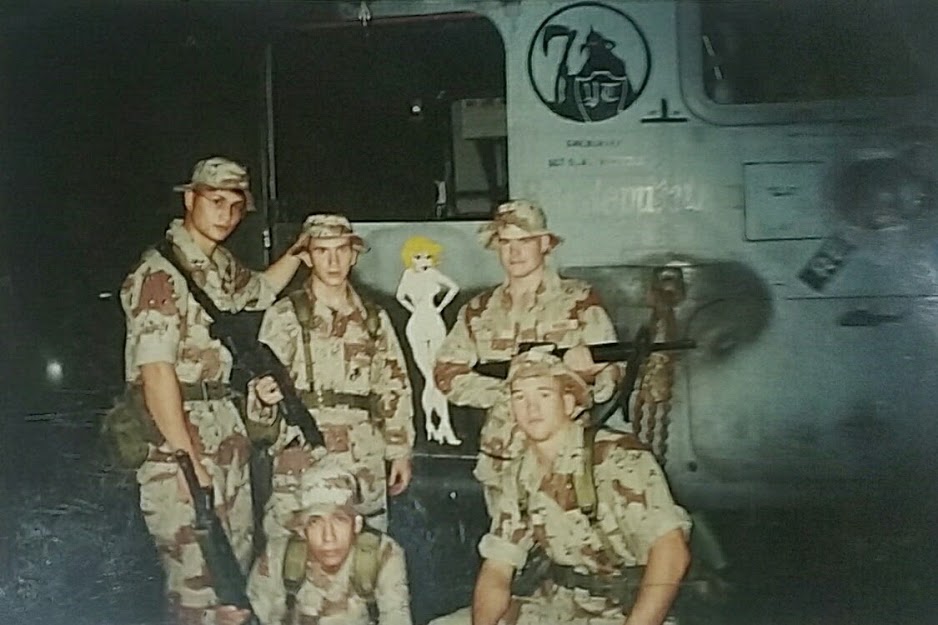
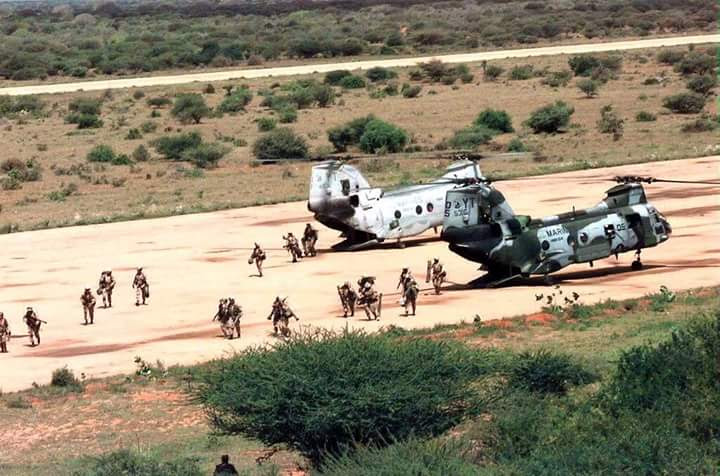
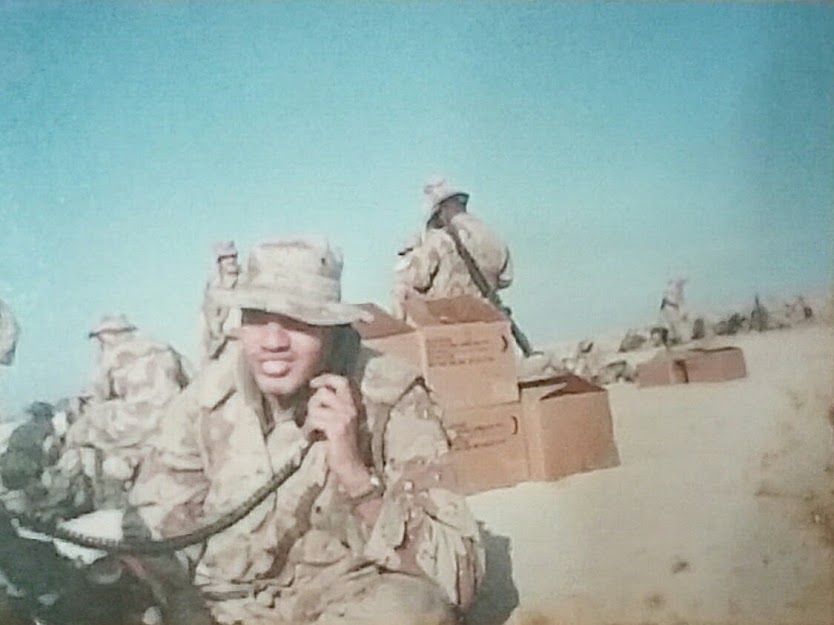
December 8, 1992 I was on a CH46 sitting next to Scrappy attached to 2nd Platoon Echo Company. I weighed approximately 120 lbs carrying about 100 lbs of gear (4 canteens of water, 7 mags of 556, 4 grenades, an ass pack full of gear, a bandoleer of 556 around my neck, and two amo cans of 762 around my neck, my M16a2, M60E3 spare barrel kit, and a full ALICE pack). In our desert cammies, but no desert boots. I suppose we should thank the 5th Marines because it was the black boots we had to wear that led to our nickname.
The helos took off from the fight deck of the USS Tripoli, and inbound to Mogadishu–it’s early morning but still dark outside. We’re flying in when Scrappy looks out the window and taps me to look out the window. I look out the window to see flash everywhere aimed at our helos. I cannot fully describe the feeling we experienced when a sudden realization sets in that you’re going in where someone doesn’t like you and doesn’t want you. I felt my left breast pocket to make sure my letter home is there and hope I wrote the right things. Scrappy yells out, “we’re going in hot!” We locked and loaded. You suck it up and do what you have to do.
When the helo landed we ran out locked and loaded fully expecting to come in hot with gun fire from everywhere. I am running out of the helo, my foot hits soft sand and I fell flat on my face. Not missing a beat, Scrappy who is running behind me, grabs on my ALICE pack and I use the momentum to get up and keep going. It is amazing how all of a sudden I was a fan of his. He and I have stayed in touch ever since. Once I recover, I realize we’re not taking fire. We later discovered that the flashes were mostly camera flash, but we did not know that reporters were going to be there so we thought it was gunfire. How often do you willingly run into what you expect to be a barrage of gunfire knowing full well you may not make it, but hope you will?
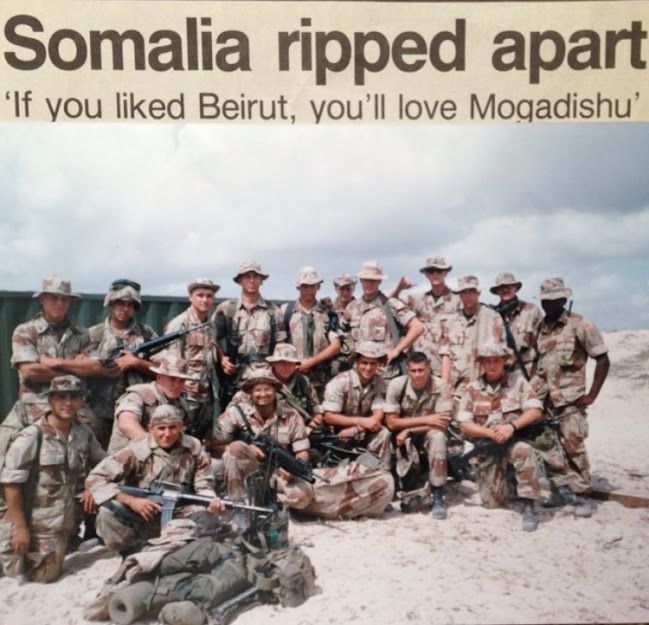
Echo Company 2nd Battalion 9th Marines | Operation Restore Hope | Somalia (Picture is not mine).
Once on the ground 2nd platoon headed out of Mogadishu Airport and set up check points in the streets of Mogadishu. I set up with the machine gun team to provide cover to 2nd platoon, who was busy conducting vehicle searches, stopping civilians, patting people down, and confiscating weapons–there was a lot of weapons. There were technicals everywhere in the distance.
I remember the Somali kids coming up to us, very curious, and saying hello–a lot of them spoke English. I like the kids at first, until we realized they knew too much and were hanging around everywhere. They were able to identify the type of weapons we carried along with their max and effective ranges. From that point, we didn’t interact with the locals in a friendly manner nor let them interact with us closely on patrols, and definitely did not allow them to hang around where we have set up for the night. We kicked them out forcefully when they didn’t listen. As we took over a city or town, we handed the town over to the Army and they handed out candy to the kids despite our advice to them to not trust the kids nor the locals.
I think this is when the Somalis started to think differently of us from the other units. When the Army came in they had their desert boots and were nice to the locals. 2/9 on the other hand saw everyone as potential hostiles and did not care to be nice to the locals. When the locals got too close to our patrols to come say hello we’d forcefully kick them out. I’m sure we hurt plenty who would not listen. As the days progressed we had Marines from 2/9 who took out their frustration on the locals–the memorable occasions involved Marines who were former boxers. We definitely conducted ourselves in a rougher manner than the soldiers who came in after us. We found out the locals identified our battalion by our black boots, and they’d announce our arrival when we reached a town or city.
Other Marine units caught on to the fact that the locals were scared of 2/9 and started to wear black boots to make them think it was us. (In 2021, I met a Marine who stated that his unit was ordered to paint their boots black because of 2/9). I write this to make a point–yes there were other units that came in after us with black boots, but 2/9 is the black boot battalion.
The Embassy
Echo Company was ordered to take and secure the U.S. Embassy. We mounted the 5 tons and went on our way. When we got there we prepared outside and rushed into the embassy grounds. As I ran to the embassy gates a photographer decided to get in front of me to snap a picture. I was carrying a lot of gear to simply move around him so instinct kicked in and I forcefully moved him out of the way–I swung my M16 and struck him with the butt of my rifle, causing him to fall to the ground in front of me then I immediately kicked him to get him out of the way so that the Marines behind me wouldn’t trip. It all happened very quickly. I heard later that I broke his arm.
U.S Embassy in Somalia
The 0311s cleared the embassy compound going through hallways and doorways heavily loaded, some with AT4s on their backs. I recall 0311s complaining about the absurdity of carrying an AT4 when trying to clear a room.
The rules of engagement were unclear and were changing constantly.
With the embassy secured and the U.S flag flying over the embassy, 2nd Platoon was ordered to patrol and secure the perimeter and of course my machine gun squad was attached to the patrol. The patrol began taking sniper fire almost immediately. The patrol leader called in the incident, and the patrol was ordered to neutralize the sniper, to advance on the sniper without firing back. The rules of engagement were unclear and were changing constantly. We couldn’t shoot unless shot at, and there were many changes until ultimately and the last one I remember was that we could not shoot even if we were fired upon–we needed permission to do so.
There we were taking fire from a sniper.
It was unreal. There we were taking fire from a sniper advancing towards the sound of gunfire one by one taking cover without being able to shoot back. Lucky for us the sniper was a terrible shot. As surreal as the whole thing seemed, we followed orders and did not shoot back. By the time the patrol neared the source, the shooting stopped and the shooter was gone.
Upon returning to the embassy, we saw some overweight reporters hanging around who were allowed to roam around more freely than other reporters. We later heard that those reporters were really CIA. A few days later, LCPL Dorscher told me how the same agents were blown up when they accompanied his patrol and they stepped on a landmine. LCPL Rick “Ponyboy” Arnold, stayed behind on the Tripoli working ship’s platoon, said he saw the bodies coming on board for the morgue.
I remember Ponyboy telling, after leaving Somalia, that when he saw the body bags coming aboard the USS Tripoli he was upset and filled with emotion because he thought they were Marines–Marines, one of us. When the bodies arrived on ship they weren’t told who they were.
From here on out Echo Company 2/9 was the spearhead going from city to city, town to town, and village to village to secure them, and turn them over to the U.S. Army. Too much time has passed by for me to remember which town we went to after Mogadishu and the order in which we did so, but I do know 2/9 hit every city/town/village; Baidoa (described as the City of Death), Kismayo, Bale Dogle, and I know there were more, but I can’t remember their names so I’ll have to research.
The Beach
We went back to the beach at one point, and fell into formation, put at ease, and allowed to sit down. By this point the heat in Somalia gave us all prickly heat–it was unbearable. The slightest movement set it off and my skin lit up with pain from needles within my skin. The section leaders let us take off our blouses to get some comfort. Almost immediately, Gunny Rod comes over and chews us out and yells at us to put our blouses back on. Oh the pain, but the gear came back on.
Lcpl Carlos Garcia with Echo 2nd Battalion 9th Marines Weapons Platoon
Call EOD
I do not remember the name of the town, however I remember when we arrived that the streets were full of people. There was activity everywhere. The following morning Sean “Bunny” McCowin (mortarman) and I were standing firewatch in front of the building where the unit took up residence for the night, but his morning was different. The streets were empty and quiet, I stopped a boy who was running and asked where was everyone. The boy responded that no one was coming out because we were going to be attacked. I radioed the info back to Echo Actual and received a roger that. So, McCowin and I continued our watch.
Standing there fully aware that we could be attacked at any moment, McCowin and I made small talk until something caught my eye in a pile of trash next to us. I took my M16 and used the barrel to move some trash. Staring back at us was some ordinance. It looked like a mortar round conveniently placed next to the entrance. We called EOD to get rid of the round and detonated it somewhere away from us.
Thirsty
2nd Platoon was sent on patrol of the town. It was a hot day, and we’d already been in Somalia for some time–weeks now. While on patrol we started to get an audience, people who tried to accompany us and get in the middle of our patrol. We immediately kicked them out from our patrol by force if necessary. We did not allow Somalis to come between our patrols so if we had to get rough and forcibly remove them then we did so. The truth is that we did not know them, we could not trust that they did not have explosives.
It was a hot day, I had already taken a swig or two from one of my four canteens. I small kid, maybe about 9 years old, came up to me asking for water. I said no, and pushed him away. I have to give him credit for his tenacity because he kept trying. He came back again and again I said no and pushed him away. He came back again a third time, but this time he grabbed my canteen so I struck him with the butt of my rifle across the face and knocked him down. He didn’t try again. In retelling this story I’ve gotten mixed reactions, but mostly horror at the idea of me hitting a kid in the face, and why didn’t I just hand him my canteen. Well, at that moment in time I didn’t know his intention–whether he was really thirsty or had nefarious intent and wanted to slip something into my water. Ah, I love the Marine Corps.
The Skull
In the first few days in country, we patrolled a town and finally stopped to settle in. The LT gave the order to dig in which meant to literally make a hole to sleep in and set up our weapons. Well word soon spread that the area we were in was a cemetery so no one that I saw was digging. I wasn’t digging. I recall the LT getting very upset at our refusal to dig in in a cemetery, but he ordered us to move to right outside of the cemetery and dig in. Which we happily obeyed.
When daylight hit, I ran into LCPL Dorscher who told us about a local Somali who was looking at his hole. The Somali came up and told him how nice his hole was and asked Dorscher if he can have the hole when we move out. Dorscher was confused until the man told him that he wanted to use the hole to die in. Dorscher said sure, but only when and after we moved out.
Around the same time, there was another Marine who found a skull when he was digging in. He showed it to us and other Marines. I remember that he gave it a name and put the skull in his ALICE pack. He carried that skull with him from that day forward, and only reluctantly discarded it when we were going back to ship. He tried to think of ways to keep that skull, but the only reason he got rid of it was because he was concerned it was going to be discovered if a gear inspection was done on ship. After leaving Somalia, this same Marine was arrested in Dubai for getting drunk and stealing a car–I believe it was a Ferrari. He went from Corporal to Private after the Dubai incident.
Near Miss
The nights were dark in Somalia. I grew up in the city and the closest I have experienced to country living was while on Camp Pendleton. I grew up not knowing what a sky looks like without the city lighting up sky at night. One night while standing watch behind the M60. I heard some noise on the other end of our line not far away. I cocked and loaded the M60, leaned my shoulder into the butt stock and prepared to fire into the voices. As I prepared to fire, I thought I heard Americans speaking English. I listened closely and sure enough it was English, it was another squad coming in from a patrol on the the wrong side. I put the safety on the 60, and took a deep breath.
The Theater
The squad was on a night patrol in Mogadishu, and I remember being excited to see Lcpl Garcia, a New Yorker, who I had not seen often since we landed in Somalia. Garcia was a calm and collected guy that always took time to contemplate before making a big decision, especially when it came to spending. I do not recall what platoon and squad he was attached to, but here he was carrying the radio for the patrol.
“Echo one actual, we’re taking fire over.”
The patrol stopped and I approached Garcia to catch up while we had the chance. As luck would have it that we started taking fire, some of it hitting the ground at our feet between me and Garcia. He and I took cover behind some large metal barrels near us, and Garcia radioed our situation. “Echo one actual, we’re taking fire over.” The response came back, “Roget that” followed by radio silence. Honestly, he and I were under the impression that we interrupted someone’s sleep. Nonetheless without approval to engage our options were limited.
The squad leader led the patrol into the building behind us for cover with the intent to go around back and approach the source. He’d radio in on the way there for further instruction. Upon entering the building we discovered that it was a movie theater. We were in the front running past the screen with a movie playing as the audience in the front row viewed on. We made it outside and continued the patrol working our away around to get to what we thought was the source of the gunfire. We couldn’t find the source or the individuals left, but the rest of the night was silent. We finished our patrol and headed back.
Since writing this, I had an opportunity to speak to Garcia. I was happy to hear from him. He recalls this patrol and mentioned how lucky we were. He recalled the AK47 rounds at our feet. He also mentioned that a grenade was thrown at us and that we were so lucky that it didn’t detonate. I told him that I didn’t recall a grenade, but he said he remembers and remembers it vividly. He sounded shaken talking about it and described how it landed by the both of us.
Other Patrols and Memories
The Cache
On another patrol, in another town, there was a small boy staying close to our patrol although he kept his distance. I took it upon myself to call him towards me and question him. This kid didn’t speak English, but I was able to understand what he was trying to tell me. I understood that there was a compound with guns and ammo. I stopped the patrol and alerted Sgt. Knight (mortars section leader) who was leading the patrol. We lined up outside the ,compound, broke the down the door, and made our way into the compound. We found so many crates of weapons, and ammo that we had to call in for Amtraks to haul it all away.
Sgt. Knight led another patrol where we had to enter another compound. The compound had a set of stairs outside the compound entrance. We lined up outside ready to go in, when doc pushed his way to the front with his pistol in the ready. He pushed me and other Marines out of the way because he wanted to be towards the front when we broke down the gate/entrance and worked our way in. Honestly, I just looked on in awe until Sgt. Knight grabbed him and sent him back to the end . We broke the door down and made our way in. I don’t remember if we came up with anything at this compound, but the memory of Doc pushing Marines out of the way with his pistol always gets a laugh out of me.
The Bride
There was a Marine, a machine gunner, who was always cracking jokes. He wasn’t a clown, far from it, but he had his moments when he made us laugh. When we were in a small town in Somalia and had been there for a couple of days, we started to hear rumors that this Marine married a local girl–that her family was exited that she would be able to move to U.S. Apparently, this Marine was sneaking out and spending time with his new wife at night. At first, I didn’t know if this was just a rumor and a joke, but when we started seeing the girl and family trying to find him.
The French Foreign Legion
The rules of engagement where terrible from the get go, when we got on the helo the first day we had one set of ROE, by the time we landed, they changed, and continued to change day-by-day and throughout the day. There was one unit that seemed to run around the country being bad asses and like 2/9 they didn’t take shit–The French Foreign Legion.
There was one event that had us in awe. One day the Legion drives into the middle of town, the door to their vehicle opens, Legionnaires step out followed by a Somali woman. Once the woman steps out, the Legionnaires get back in their vehicle and drive away. The locals approach the woman, visibly angry, surround her and take her away. We looked at each other and start to chat about how cold blooded they were.
Christmas
On Christmas day 1992, Gunny Rod sent me back to the Tripoli. I don’t know why, but I was happy to get a break. I took a hot shower on ship, some hot chow, and watched The Grinch Who Stole Christmas. The berthing area was empty, but I was able to say hello to Arnold before going back to Mogadishu.
Welcome Home
When we left Somalia, we made our way to some libo ports before heading back to Camp Pendleton. When we finally made it home we discovered that there was a parade for the unit that spearheaded Operation Restore Hope. However, as luck would have it was 1st Battalion 7th Marines who received the hero’s welcome. We had a good laugh about that.
Negrete and I made plans to head to L.A. once libo was sounded, so when it was I grabbed my gear, found Negrete’s Camaro, and we were on our way. We arrived at my parent’s place and when I reached the door, my key would not open the door. I knocked, waited, then when someone comes to the door I did not recognize them. I ask for my parents and they tell me that they’re the new owners and they do not have an address for my parents. They mention that they do know that they moved closed to a school.
I look back at the street and Negrete was still there. I tell him what happened and ask if he can drop me off at a hotel. He offers to drive me around to look for my parent’s cars. So we head for the closest school and start looking. We start driving the streets around the school. I thought it was a waste of time, but as luck would have it, I recognize my mom’s car. Negrete stops the car, I get out, knock on the door, and my mom answers.
My mom is exited to see me. Of course, I have a little fun and ask why she didn’t write to tell me that they had moved and she says she did–damn post office.
This was an interesting video to watch. Growing up, I heard various terms to describe me throughout the years from Mexican, Chicano, Hispanic, Latino, and now Latinx.
Ultimately, I grew up using Latino and Hispanic as interchangeable words to describe me. Of course the word Mexican was always in the mix, but that one depends with whom I am speaking. For example speaking to non Hispanics I can describe myself as Mexican. I can also use the word to identify myself with other Hispanics as long as they are not Mexican citizens. I am not considered Mexican by Hispanics born in Mexico.
Early this this year I moved back to the U.S. after living in Buenos Aires working in Argentina & Uruguay. I was shocked to discover that I am not considered Latino in Argentina, Uruguay, and throughout Latin America. I am considered a Yankee. Growing up in the U.S., I heard Mexican nationals call me Gringo, but I assumed it was jokingly–now I know they genuinely called me a Gringo.
I began to ask how it may be possible that I am not Latino. Sure, I was born in the U.S. but my first and last name are Spanish and my family was originally from Jalisco, Mexico. The replies were all the same. I am not Latino because Latino refers to someone born in and who grew up in Latin America. I never once heard the term Hispanic in Latin America, but even then they acquiesced in agreeing that I am Hispanic.
I have come to accept that I am Latino in the U.S, but outside the U.S. I am an American/U.S. citizen/estadounidense of Mexican ancestry, but not Latino. I did not hear the term Latinx in LATAM. So, my question now is, “Am I Latinx only in the U.S.?
This week I had the pleasure of attending an event hosted by the San Antonio LGBT Chamber of Commerce, and listened to Phil Bohlender speak. I previously met Phil at another event hosted by iEmpower, but we only exchanged names. Well today, I discovered that Phil has a 35 year corporate career holding numerous leadership and consulting roles with international experience.
I consider myself a champion of diversity, but in all honesty, I did not truly understand how someone’s sexual orientation was relevant in the workplace. I don’t recall ever asking nor worrying about someone’s sexual orientation neither in the workplace nor outside of it. So, my reason for attending was a genuine desire to listen, learn, and understand.
Phil started out by sharing personal experiences that started in the 80s. His presentation included a 2018 Harvard Business Review article by Trau, O’Leary, and Brown–7 Myths About Coming Out at Work. Most of the myths made sense, but I quietly thought to myself that #3 Coming out has nothing to do with work still did not make sense to me aside from dealing with individuals who may be prejudiced and/or closed minded.
What does Coming Out have to do with work?
What I loved about the event was the level of interaction by Phil and the audience that quickly allowed participants to share their experiences and ask questions. As I sat there taking in all the information, digesting ideas, an attendee spoke about the very myth that I did not truly understand. He stated that Coming Out does have to do with work. He mentioned that most companies have work functions where employee take their significant others or share stories about their families. So in his words, of course it matters.
That was my aha moment. wow
I thought of the many company Christmas parties and events that my wife attended with me. I though of the many internal contacts, mentors, and sponsors with whom I shared stories about my wife and kids. I thought of the many personal development events that encourage us to be authentic in the workplace, encourage professionals to gain exposure within your organization in order to climb up the ladder. I imagined someone who cannot be themselves at the workplace, cannot talk about their spouse or significant other.
I started to understand. Happy that I am still learning
The only person who can stop you from reaching your goals is yourself…Stop! saying the words “I can’t.” Forever replace them with the words “I can” and “I will!” Fight to make your dreams tomorrow’s reality.
MLK
This is the first post on my new blog. I’m just getting this new blog going, so stay tuned for more. Subscribe below to get notified when I post new updates.











 Isidro V. Reyes