I will preface by saying that I am far from being an Internet of Things (IoT) subject matter expert, but I like new and emerging technology. I was excited when IoT finally made it to the consumer side and the rise in implementation that occurred in the consumer side. I did a lot of reading before making an investment into an IoT ecosystem for my home–having to decide amongst Zigbee, Z-wave, and Wi-Fi.
I did not know terms like emerging tech, nor that the dominant design was still up for grabs. I remember being a small kid in the 80s when the market had Beta and VHS VCRs. My brother and I saved up the money we earned from helping my dad on the weekends–he was a small business owner. My mom and dad drove us to the electronics store and there we were. My brother and I looking at the wall full of VCRs. We were too young to know the difference between Beta and VHS, so we just selected one, and we bought and brought to first VCR into our home. We were lucky that we picked a VHS.
I found myself in the same situation, but now as an adult and doing research so that I would not end up with the “Beta” of IoT. I picked Z-wave–time will tell if I did well or not, but we’re all in.
As I invested in IoT at home, I was eagerly awaiting for implementation in the commercial side. I began to read more and more about it–joining groups and following SMEs on the topic awaiting the rise of IoT in the commercial side. It’s been years (I was living in DFW) at the time, and still not much progress. Everything I read name underscored three barriers:
Bandwith and speed to link all data together and process it
creating technology standards so that different devices work together
Once the reality of the pandemic hit, and enterprises were adapting to this new environment and how to manage the built environment, I thought for sure that this was the time for IoT to shine. I ran across and read many articles of the benefits IoT brings to the built environment vis a vis to health and safety.
Facility Executive put out a great article about the IoT/smart buildings and the post pandemic with great content. the article mentions occupancy monitoring. This is one of the benefits I was personally waiting for. When I was with ISS some of my colleagues were piloting sensors affixed to work stations that provide real-time data about whether a work station was occupied and/or vacant. I thought of the application in 2020 and beyond. The sensors can alert an enterprise if social distancing is not observed. I know it’s a bit big brother-ish, but at the moment I’m considering the case use.
Did IoT miss an opportunity?
The same article discusses real-time data about fresh air intact via the IoT enabled HVAC systems, but I do not want to digress from my point. The three barriers that existed 6 or 7 years ago still exist today. The speed of adaptation is faster on the consumer side, and while the commercial side makes small steps (I get it–we’ve heard the stories of toasters that’ve been hacked), I can imagine a future of truly smart, IoT enabled buildings and cities.
In 2006, I received a call from Canutillo Independent School District. The person on the phone asked if I was still interested in the head custodian role for which I applied. Thank God! I said yes.
By coincidence the same day that I started my first day of work, the crew was also waiting for a temp to help with the summer projects. I’m not sure if they were expecting someone older, but when I arrived the crew handed me a putty knife and some cardboard and instructed me to begin scrapping the wax from the edges and corners of the gym floor along the wall. I know that I could have introduced myself. I know that I could have easily stated that I was their new boss, but I figured lets see where this will lead. The crew was respectful, and best of all they enjoyed their job. They laughed and joked and told stories while they worked. They checked on me frequently to make sure I had the hang of it and to make sure I had plenty of break time.
Sometime later that morning, the principal for the campus showed up. She was speaking to the the two gentleman who had taken initiative and took charge of the day. I was able to hear the principle ask the two gentleman if Mr. Reyes had shown up. They replied that the only person to show up that day was a temp. They pointed in my direction and the principle yelled, “Mr. Reyes!”
I was introduced to the team, I said a couple of words, then went on our way. They didn’t take it bad that I did not introduce myself instead they laughed it off–actually we laughed it off.
I didn’t last long in that role, because the same year I was called to the superintendent’s office because of a budget I submitted. Apparently, the administration liked the format and thought that went into the budget that they inquired about my background. When I went into the superintendent’s office, I was told about an objective that they have been unsuccessful in realizing. they wanted to create a centralized soft services department with an emphasize on custodial operation.
The district had a decentralized operation whereby the principal of each campus oversaw custodial staff, training, equipment, supply, training, and SOP. The result is that every campus operated differently, different equipment, different supplies, and different methods of acceptable cleaning and disinfection. The district proposed creating a centralized department whereby the new department head will oversee all custodial operations removing the principals from each site from the decision making process.
I thought for a second, then replied that I am willing to take on the challenge, but that I recommend we create a matrix organization instead of the traditional top down organizational structure. I recommended that the principals remain an active stakeholder in the leadership and decision making process. The principals can retain day-to-day oversight allowing for faster response they need to react to day-to-day needs, while the new department will take on training, SOP, equipment lists/supplies, discipline, and budgets.
Upon starting my new role, there was now a position to fill–the role I just left. The district began the recruiting process–external and internal candidates applied.
Upon starting my new role, I made the time to visit the many campuses in the district. I took notes of the following observations. My first observation is that the leadership roles in the department were held by Hispanics/Latinos. My second observation is that the city is more than 90% percent Hispanic/Latino so it made sense that the leadership team be representative of the city.
My third observation is that I did not see any women in leadership roles in the facilities department–in neither janitorial nor maintenance. The former having a high percentage of women in the department.
I continued to tour the campuses. While doing so I encouraged qualified individuals to apply for the open head custodian role. The men were eager to apply while I found myself convincing the qualified women to apply. I often heard from them that those roles were for men even if it wasn’t written. I didn’t convinced many women to apply, I even had a principal tell me that if it were her campus she’d want a man to oversee her campus’ custodial operation (not this campus’ principal).
I’ll cut to the chase reveal that a woman was selected for the role of head custodian–that was a promotion for her. I honestly believe she was the most qualified individual who applied.
After she was promoted, I visited the campuses and I had many women who held roles as custodians come up to me and express how shocked a woman was promoted. They expressed that they thought it was a rule that men had to hold that position. I now had women ask me what they had to do to get promoted to assistant head custodian or head custodian.
I’d like to say that things were great from that point on vis a vis diversity and inclusion, but things take time and so did it here. The first step was promoting, or hiring, a qualified individual. The next step was following up with her to make sure her direct reports listened to her and her directives.
This was not the only place I encountered resistance. After leaving the school district and moving back into the private sector, I had women in leadership roles express frustration with their direct reports who would not listen to them. I had women in leadership roles call me on the phone and pass the phone over to their male team member so that I would tell them to do as she asked.
To me, this story is a perfect example of why representation matters. The ladies I encountered had not seen a woman in a position of leadership so they assumed they couldn’t and didn’t try. The men hadn’t seen a woman in charge and couldn’t believe they had to listen to a woman. This was the 2000s.
My observation of the cleaning and janitorial industry is that women make up a large percentage of the workforce, but account for a very small percentage in leadership roles. I would often hear that knowing how to perform floor work (strip & wax) is a prerequisite in order to be a supervisor. Yet, women were not encouraged to learn floor work.
What other prerequisites exist that limit representation? I think about who I am inviting to lunch. I think about who I call to say hello or check up on.
Since then, I have been involved with helping promote diversity, equity, and inclusion. I joined The National Society for Hispanic MBAs (NSHMBA) while living in DFW. I appreciated how inclusive the organization was–inviting and working with many other groups. I served on the board of Prospanica (fka NSHMBAs) as the VP of Corporate Relations, then as the Executive Vice President for the San Antonio Chapter. While in Argentina, I moved my organization to participate in events with The Red Shoe Movement to promote women in leadership. To this day, I am involved in my organization’s ERG.
In 2006, My family and I relocated to El Paso, Texas. At first I had difficulty finding a job in distribution/fulfillment/e-commerce. In order to support the family, I took a temp job running the receiving department for a company that manufactured server racks in Santa Teresa, New Mexico. I was making minimum wage (a huge pay cut from what my family and I were accustomed), but by paying off bills, and reducing monthly expenses we made it work. By the way, the organization took me on because they had difficulty finding someone with SAP experience–although I did have to convince them that I knew what I was doing. Lucky for me, I started my career in the Dotcoms of the 90s, so I had experience with SAP implementation and staff training.
I enjoyed the job–it was a swing shift position, but I enjoyed the camaraderie of my coworkers. I purchased a 4×4 Chevy Blazer and that made ride home enjoyable. Once my shift was over, I sat behind the driver seat, put on my black cowboy hat, started my car, and drove the dark dessert rode home. I was blasting country music–the only thing on the radio. It turned out to be a nice competition to see who reached El Paso first. I truly enjoyed the drive.
Before starting this job, I applied at various organizations, so I did eventually find a better paying job running HSSE for a manufacturer in downtown El Paso–it was a multi-plant operation.
I was excited to positively contribute to the well being and safety of the organization’s workforce. I was excited to no longer be making minimum wage. I sat in my office in the morning, turned on my computer, poured a cup of coffee then began my morning by walking the main facility. I loved greeting the employees when they reported to work, checking in with the security officers to see what was reported in the log books from the night before.
The company made blue jeans for larger well known brands–like The Gap (this is important later).
I soon found out that the company had had an explosion and fire before I moved to El Paso–luckily, no one was hurt with that explosion. As a consequence OSHA was frequently inspecting the site. also started to realize that the HSSE role was there as a show and was not a role that was truly valued nor supported by the organization. The intent of the company was not to resolve issues nor mitigate possible injuries, but rather to make it difficult for employees who got injured or wanted to discuss deficiencies. Nonetheless, I was determined to make changes and positively impact the organization.
I recall the first time someone got injured I was reproached for documenting it instead of encouraging the employee to just get back to work. I believe the company got away with it’s tactics because it’s workforce was made up mostly of Mexican nationals who legally crossed the border every morning to come to work.
Flammable
As I was leaving to lunch one afternoon, I looked left towards the chemical storage area of the facility. I was already at the main entrance and I continued to walk out and making a mental note to visit the area upon returning from lunch. I stepped outside, but I kept getting a feeling that I truly needed to check that area. I turned around, walked back into the facility, and made my way into the chemical storage area.
When I walked through the plastic curtains that separated the area from the rest of the plant, I saw a maintenance technician getting ready to start a welding torch next to a large chemical container with labels on it identifying the contents as highly flammable and to keep away from flames. He was right next to it.
I informed him that the situation was not safe and that I need him to please move to a safer and more distant spot. He very sternly replied that I was not his boss and that he had a job to do, and that he was going to do it. I showed him the labels and explained the severity of the situation, but he was undeterred. Finally, I explained to him that he may not be concerned for his safety, but that I was concerned for the safety of his colleagues. I asked him to wait until I evacuated the area before he continued. He looked at me, looked at his colleagues who began to leave and reconsidered. He picked up his equipment and went somewhere safer to complete his task.
Wrinkly Jeans
On another day, I was walking the area where they create the distressed or wrinkle look on jeans. The process entailed placing jeans on a mannequin then spraying the jeans with a resin to create the look. The area was a separate enclosed room with many mannequins lined up next to each other with glass walls so that people passing by can look in. I looked in and realized that no one is wearing safety glasses, gloves, respirators, nor safety suits. I am immediately concerned, walk in, and stop production.
I inform the team that they need to wear full suits and gloves to prevent spraying on their skin, that they need to wear respirators so that they do not breathe in the chemical, and that they need to wear safety glasses to protect their eyes. I informed them that they are in close proximity to each other and that they can spray one another by accident. The employees put on the PPE I required, so I move on to another section of the facility.
The next morning I come in, and I am informed that everyone took the PPE off after I left. I am also informed that one of the employees working in that area was sprayed in the eye with resin and he had to be rushed to the emergency room.
Wrinkly Too
On a separate day, I walked into another station where ladies were lined up at ironing stations. Their job is to put jeans on the device, spray resin on the jean, and press a hot iron onto the jeans. As I walk by I notice that they are not wearing, safety glasses, gloves, nor masks. I mention that they should wear them and I begin to listen to complains about how uncomfortable PPE is. As I walk away, I chemist who happens to work at the plant tells me that he is happy to hear what I did. He said he was always concerned that they do not wear appropriate PPE. He continues to tell me that that resin at high temperatures is a carcinogen.
The next day I walk into the same area and no one is wearing their PPE. I speak to the department head who informs me that buying PPE is too costly. He said he’d consider it if the employees can reuse the same gloves and face masks so that his cost does not increase.
24 Hour Shifts
As I was making my rounds one morning, I walked into the area full of sewing machines and saw a group of ladies who I said hello to the day before. i don’t know why I noticed it, but I noticed that they were wearing the same clothes as the day before. I walked over and said hello and asked how they were doing. They replied that they were tired from their long shift. I was a bit surprised because I saw them yesterday and said that they’re sift just started. They told me they had yet to leave and had worked a 24 hour shift. Another lady replied that she was on 26 hours.
I was shocked. I went to their boss and asked it that is possible and he replied that it was true. I then went to HR to find out why we have employees working such long shifts. I mentioned that that cannot be good, and how is that even legal. I was told that no laws were broken. I was also told not to worry because they weren’t going to get overtime pay because they’d only be allowed to work 40 hours. I mentioned that I wasn’t worried about the overtime pay rather their health and well being. How can it be safe for anyone to work 24 to 26 hours sitting behind a sewing machine. Again I was told the company did nothing illegal.
At this point, I knew the practice of having employees work shifts this long was antithetical to everything I learned and was taught about leadership. I had to do something. I went directly to the owners to plea my case, but I was met with the same stance that the organization did nothing wrong. By this point though, I knew the company was acting contrary to clauses within the contract they had with The Gap. The contract clearly prohibited such actions and enumerated the maximum number of hours an employee can work daily and weekly (including overtime). Ultimately, The Gap did not want to be working with sweatshops and expose workers to unsafe conditions. I brought this up to HR and the owners and was told that that is why they have employees carry two timecards–one for regular hours and one for anything beyond the specified number of hours in a day or week. If the company gets audited they just hide the second timecard and as far as the clients know they are always compliant.
Ambivalence
I did what I thought was right. After my appeals failed, I called The Gap and informed them of the work practices along with how they bypass any client audits. I then submitted my resignation effective immediately. I couldn’t help but have mixed feelings about the whole thing as I drove away in my Chevy Blazer. Was there anything else I could have done? Will the employees coming over from Mexico be okay? Oh, and then there is the matter of not having a job.
Lucky for me, I received a call about a job with Canutillo Independent School District.
I don’t remember the exact date but it was in early 1992 when we were ready to finish school of infantry (SOI) that I received my orders. Up until this point, I had been accustomed to familiar faces and names of individuals with whom I went through boot camp, Marine Combat Training (MCT), and SOI, but as everyone received their orders, it dawned on me that the group of Marines with whom I became friends would no longer be together.
I received orders to report to 2nd Battalion 9th Marines in Camp Mateo–the northern most point within Camp Pendleton neighboring San Clemente. Although I was the only one going to 2/9 from my group of friends, others in our SOI class were also going to 2/9, and stories soon started to circulate.
The 9th Marines lost their colors in Vietnam because they were overrun by the VC and many died. I heard the stories about the 1/9 who earned the title the Walking Dead–they got overrun and had to call arty on their own pos and when it was all over only ten Marines survived, as a side note I got to meet one of the ten survivors later in life. I was never certain how the 9th regiment ended up losing their colors as a whole but they did. The regiment was split up and 2/9 was now a battalion of the 5th Marines.
I soon heard stories that 2/9 was now a battalion made of misfits, troublemakers, and former gang members. 2/9’s budget was never enough and to make matters worse 2/9 gets the left overs scraps that the 5th Marines doesn’t want–that’s the reason 2/9 still had Vietnam era gear. I don’t know if any of that was true but at the time it was quite a story.
I don’t vividly remember reporting into 2/9. The experience is a blur except for wearing my alphas then going over to the barracks. The drive to 2/9 wasn’t far–it was a short drive to Camp Mateo from SOI, one exit south of San Clemente off the 5. I was now a fleet Marine with Echo 2/9 Weapons Platoon machine gun section.
Welcome to the Fleet
I don’t know how long it took after we arrived but I remember seeing Marines running in the barracks hallway and looking for places to hide. I was hanging out with another Marine who told me to follow him and run. We ran to his car where he locked the doors. He told me that they are looking for the Marines new to the fleet and fresh out of SOI to initiate them.
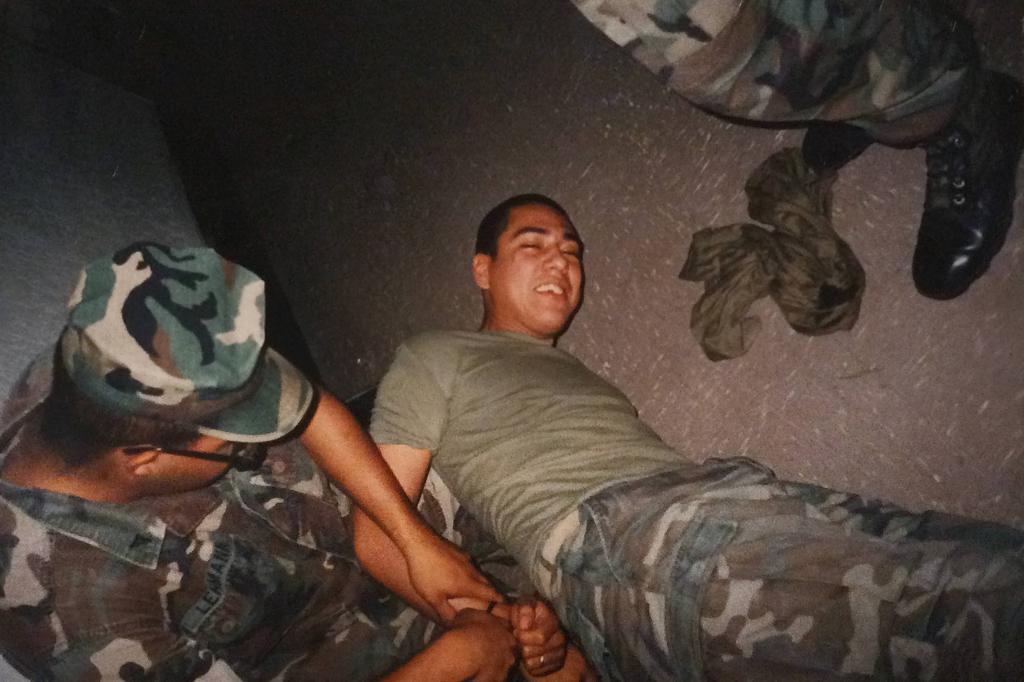
The initiation ritual involved many Marines holding down the new Marine and pulling up their t-shirt while the rest of the platoon (or section) uses the thickest sandals available to repeatedly beat on their stomach. Before they were done, they were covered in hot sauce. He told me that they’ll keep looking for the new Marines until they’re all initiated.
I’m not sure if it was just pragmatism on my part, I certainly wasn’t trying to be brave or make a point, but one thing for sure is that I did not want to keep running for days nor did I feel like hiding. So, I stepped out of the car walked into the barracks and made my way towards the Marines. They had just finished initiating another Marine whose belly was completely red. They looked at me and ran to get me. When they grabbed me I told them to go ahead that I just wanted them to get it over with. They looked disappointed then one of them yelled, “there’s another!” They left me alone. They did eventually catch the Marine who hid in his car.
There were so many initiation rituals. The first time you go to the field was another, and I remember a lieutenant getting initiated in the field. Sometimes though it was just boredom that led to aggressive play–it’s tradition.
the result of not being aware of my surroundings, alone with another section
Shortly after, a Marine, in another company (I can’t remember if it was Fox or Golf), was initiated and we all heard about it–the Marine’s father was a general and some had to pay. Suddenly there were talks about hazing and how The Corps does not condone that and so on. We could tell the officers were shaken–not by the incident but that a general was involved. The whole thing was a dog and pony, and everything went back to normal after some time.
We put in a lot of field time, a lot of training. I liked being out in the field except when it was cold. I liked running with a team, setting up the machine gun, going on patrols with the 11s. Garrison was fun too especially when we would get bored and look for something to do. There was a lot of wresting, and displays of agrro with usually one section going after another. I was sitting in a room watching TV once when I didn’t realize I was alone in a room full of members of another section that eventually led to me getting hog tied. That led to us trying to capture one of theirs.
Training
We did get some good training. The word we received is that the 5th Marines were not willing or did not have the funds to give to 2/9 for good training so our battalion CO figured out an ingenious way to get us training. We went to Fort Hunter Ligget. He volunteered our battalion to participate in an exercise where the Army was testing out new tank equipment. The Army got a grunt unit to go against and 2/9 well we got a chance to train in the cold mountainous terrain going against tank units–Marine grunts do not use sleeping bags, but we used them that time.
The same thing happened in 29 Palms. The battalion CO sent us there to train. As luck would have it the 5th Marines did not have or couldn’t provide funds so we ate 3/1’s chow. 3/1 didn’t like it much, but we ate. There was a big fight while we were there that Scrappy started, but that is another story.
Looking Back
Looking back on my experience and how the CO adapted to the situation he was handed to ultimately get us training, I took a lot from that. I learned a lot from that. I learned how to look at the objective and figure out how to get there. I learned that there are many ways to accomplish what you need to accomplish. Those lessons have served me well from impetuously moving to Sacramento the day after I got out of The Corps without a job, without housing, and without family to moving to Argentina knowing that I was embarrassed of my Spanish when I first got there, and not knowing anyone when I got there.
I no longer believe the stories that the battalion was made up of misfits and troublemakers. How could it be? I was in it and so were many of the Marines who became my friends: Pangan, Huang, Ponyboy, Scrappy, Bunny, Dorscher…
It’s been one year! In February 2020, my family and I decided to start a new adventure. The day after my daughter’s 17th birthday, I packed a couple of bags and started the drive to Southern California to start a new role with a new organization. Goodbye Texas.
I arrive in Phoenix, Arizona on March 2nd and checked in for my first day with JLL. I spend a week with Jennifer Russo, a peer who helps me with org charts, portfolio summary, tech access. This is one of the best onboarding experiences I’ve had with an organization–usually it’s sink or swim. I am back on the road on March 6th leaving Phoenix headed to Los Angeles.
The plan is simple. I will arrive in Los Angeles and I will stay with my brother until the school year ends in San Antonio, TX at which point my family will join me in Southern California. I will stay with my brother three months tops–my family and I will be in our new home by the end of May.
Shortly after arriving in Southern California, Los Angeles went into lockdown and the rest of California followed shortly. There was uncertainty in the real estate market–inventory was tight and I found myself chasing after houses in the little inventory that was left. When I found a house that met our needs it was off the market by the time we reached out. When we finally found a house we discovered a new protracted funding process–financial institutions were nervous because of layoffs and furloughs.
I was introduced to my my new team. I am so lucky to have such a talented team–knowledgeable and professional. I was prepared to implement my 90 day routine that consists of observation, notes, learning, SWOT analysis, and formulating a plan. That all went out the window as the team and I adjusted to the reality that everyone was learning to deal with the pandemic.
We found ourselves implementing enhanced cleaning protocols, sourcing masks, disinfectant spray and wipes, ordering signage, and staying abreast of changing CDC recommendations. Also important, I was trying to keep the team from burning out.
I was nervous when the end of April approached. The movers were scheduled with no place to go. The family was heading out the following month. We scrambled–my brother let me stay with him longer, my in-laws took in my wife and kids (in Arizona).
We found a house, made an offer, it was accepted and we were looking forward to closing in early June.
I made tactical and incremental changes at work–small wins. The team and I analyzed data behind some pain points and monitored for improvement. I hosted my first quarterly business review. The team managed to meet targets, deadlines, and anticipated what was around the corner. All actions that positively affected the customer experience.
The close was extended and I had to divert the movers to a month-to-month storage space.
In July, I was preparing my second quarterly business review while finalizing the close, scheduling movers to pick up and move our belongings from storage to our new home. The agent met me to give me the keys, I prepared the house–made sure utilities were on. The family arrived. I hadn’t seen the kids since February 29th (it was a leap year). While the kids explored the house, I took off to the office to present the quarterly business review.
Schools were closed to in person class when the school year started. My kids attended class via Zoom. Because we tend to relocate every three to four years, our kids are adept at going to new schools and making friends. This year they learned to make new friends online and cultivate those relationships. My introverted son seemed fine, but my extroverted daughters had a difficult time.
We are fortunate that my wife jumped into action to help our daughters manage the challenges of isolation.
What a year! March 2nd is my one year anniversary with JLL and I love it here!
I found this picture on the Internet. I tried to find the original location and name of the person who took it to give credit without any luck. Beyond the graphics this has a power statement based on a German proverb.
What a true statement! A pause for reflection about what could have been, what I may have missed out on if it wasn’t for fear. At the same time though, an opportunity to reflect on the opportunities when I took a deep breath an carried on or took a step in a different trajectory.
My family and I are working through a relocation. This isn’t out first relocation, but it is the first one during a pandemic where my wife and kids are in one state while I am in another with stay-at-home orders and travel restrictions. The situation is stressful, yet manageable.
We are moving to California, leaving Texas. Texas grew on me and I learned to love it–my favorite city is Dallas and the surrounding area. I have a comfortable life in San Antonio, great friends, great neighborhood, but I was looking for that next challenge and opportunity. I was lucky to find that opportunity in California with a phenomenal company where I am surrounded by brilliant peers, coworkers, and leaders–subject matter experts in our industry.
We pulled off our relocation to San Antonio from Dallas in two weeks. Just like now, we had some trepidation about the move. We didn’t know anyone in San Antonio; we were pulling the kids out of school again; we pulled our son when he was starting his senior year; and I took a role with a smaller company–ISS. My colleagues questioned my motives. Why leave CW when I have it so good, when I made a name for myself? Why leave to a company like ISS who doesn’t have a good reputation in the US? Did I not hear of all the trouble the company has? Did I hear the CEO and COO were fired?
All valid points, but as I stood firm with my decision, I thought of the opportunity to contribute to a new organization. Sheryl Sandberg’s word in Lean In. How she left Google for opportunity for a smaller company–Facebook. I took a deep breath and carried on.
When I arrived at ISS, I stopped in middle of the street and questioned whether I made a mistake. I traded my office on the 10th floor in a class A building in Dallas for an office of what used to be a mechanic’s shop with the roll up gate serving as a wall behind my back. I inherited an operation with high turnover, low morale, old technology, and a P&L in the red. There was no turning back.
One of the first challenges I took on was the high turnover. The high rate was affecting morale, service delivery, and the customer experience. The turnover was so high the operation consisted mainly of temp labor. There was no consistency in service and customers were upset. I performed a market wage analysis and discovered that we were paying minimum wage, we were below market, and below our competitors. I understood why we could not attract nor keep employees.
In addition to starting new training and onboarding programs, I decided to give my team a wage increase to be competitive. My team expressed their worry. How could I justify giving a wage increase when the operation was losing money? I informed them of my findings and that I was taking a calculated risk that by increasing wages we would attract and retain employees. If successful we would eliminate the temp labor that came with a 35% markup. They were not convinced but followed my directive.
We had just relocated to San Antonio, I went home and told my wife not to fully unpack. I told her what I was doing at work and told her that we are if I still had a job at the end of the quarter.
Thankfully my gamble paid off and turnover reduced to industry standard with the added benefit of eliminating the temp labor markup that went back to my profit margin. We were on our way!
There were many deep breaths in my life. When I relocated to Argentina, I stopped in my tracks when I landed in Ezeiza–the sounds, smells, and signs hit me. I realized I was not in the US. I was in a different culture, with a language that I used only occasionally. When Scrappy and I were in the helo, locked and loaded, looking out the window before we landed–I could have frozen.
“Don’t act like a Marine.” I am paraphrasing the best piece of advice I received by my then boss, and mentor Jon Oka.
How Marines Grunts Perceived
Bossy, loud, obnoxious, and lacking emotion. Speaking about veterans in general, “they’re seen as doers, people who can sort of take action and get things done, but the consequences of that is people see them as sort of less feeling, having less emotion,” said Dr. Steven Shepherd, a marketing professor at Oklahoma State University speaking to Richard Sisk writing for Military.com.
Here are a some more stereotypes I have heard regarding the military in
general:
they can lead when their direct reports are
obligated to do so but leading in the civilian world is not the same as leading
in the military.
Prior service members do not know how to take
initiative.
The military makes robots
A year after getting out of the Marine Corps, I started working for Jon
leading a team tasked with replenishment, reverse logistics, inventory control,
inventory maintenance, and customer service.
I did a good job monitoring metrics and making sure that we met them and
take corrective action when possible deviation was detected.
I was focused on the mission and like a good Marine I took care of my
team—making sure they had what they needed to get the job done. All lessons I learned from the Corps. I also picked up the habit of being direct,
to the point, and assertive. The truth
is I fit the stereotype of a Unites States Marine grunt.
In the fleet, grunts follow orders—swift, immediate obedience to
orders. What is a grunt? A grunt is the infantryman whether in the Army
or the Corps. Grunts are the ground
stompers at the frontline everyone else is support. There is room for initiative, swift thinking,
and on the go decision-making necessary for successful small unit tactics that
is another story.
I was good at barking orders and making sure they were followed. One day Jon approached me and had a
one-on-one with me. He told me that I was good at organizing, planning, and controlling,
but that was not enough. He gave me some
advice. He said that if I wanted to be a
leader higher up in the chain of command that I would have to develop soft skills
especially the ability to use diplomacy and navigate corporate politics. He said that without that skill I would be
successful, but that he did not see me leaving the supervisory or frontline
management ranks. Act less like a Marine
Fast forward to 2015, I was in my office when the Director of HR walked
into my office and said that heard that I was a veteran. When I responded that I was, he said that I
must have been in the Air Force. I
responded that I served in the Marine Corps.
He returned that I must have been an officer to which I replied that I
was enlisted. He then said I must have
worked supply. I replied that I was an
infantryman. He then stated that I must
never have been sent anywhere were someone was shooting at me to which I replied
that I had. He shook his head in
disbelief. The point I did not fit his
notion (stereotype) of a Marine.
I have read some posts refuting the stereotypes. My interactions with sailors, airmen, and
some soldiers in San Antonio have taught me that in fact that stereotype does
not hold true—the caveat to all servicemembers.
I have interacted with Marine Corps and Army grunts for whom the stereotype
of lacking tact and IE/EQ holds true—I was one of them.
Of course, this advice is geared toward those already employed. My intent in this post is not to address the
obstacles in gaining employment of which there are many articles already written. I will write about some traits inherent in Marine
Corps’ grunts.
Marines run toward the sound of chaos
I cannot count how many times I have heard the saying Marines run toward
the sound of chaos/Marines round toward the sound of gunfire. Well, in my case both are true, the latter in
a literal sense as rounds were aimed at us, and I have run toward chaos ever
since leaving active duty.
I have made my career running toward organizations whose divisions or
business units are in distress, running at financial loss, or have toxic cultures
that need to me addressed. Where others may
have run away and preferred a turnkey operation with opportunities for nominal
improvement, I have thrived while keeping a cool head, and bringing up
morale. I have been called the fix it
guy more than once.
My wife once told me something shocking. She called me the fix it guy then added that
what makes me different is that while other fix it guys are known for coming in
and firing staff, I go in work with existing teams, develop them, and via
influence get their buy in for my vision of how the operation will run.
Small Unit Tactics
Isn’t that what Marine squads do?
We cannot choose who is assigned to our squads. We must train our teams to eliminate
deficiencies and perform at optimal efficiency—all those gun drills. Marines sharpen
their skills and develop teams. The belief
that Marines follow orders and cannot think for themselves is a fallacy.
Marines have been operating in small units with independence and
autonomy since November 10, 1775. They operate
in small units with a high probability of injury or death, (my MOS had a 6 to
10 second life expectancy) someone always must be ready to step in, to think on
their feet as the situation unfolds. We
were able to make decisions as long as the mission objectives were met.
I have plenty of examples where I made the call for high risk decisions
that others before me were scared to make.
One example that comes to mind is when I took over an operation that was
losing money. After analyzing the situation,
I made the call to give the staff a 16% wage increase. The operation was paying below market rate
and was experiencing high turnover.
Because of the high turnover, labor was being supplemented via a temp
agency at a cost of a 35% markup. I
took a calculated risk that increasing wages would reduce turnover thus
eliminating the need for temp labor.
The leadership team that reported to me said it was a crazy idea. How can I increase cost when we’re already
losing money? My tactic worked, and I
was able to return an annual 84K USD back to my P&L that would have been margin
paid to temp agencies. My mission was to
get the operation back into the profitability.
Mission Focused
Leading teams during difficult times requires focus, determination, tenacity,
and the ability to navigate ambiguity. This is the case in business as it is in
a combat environment. In both situations,
the rules of engagement are not clear and/or are constantly changing.
Irrespective of what difficulties pop up, situational awareness is necessary in
order to navigate through and around obstacles while reaching mission
objectives.
My Advice to Marine grunts is learn the soft skills, learn about emotional
intelligence, and get a mentor. Be proud
of being a Marine, act like a Marine—adapt and lead.
On October 19, I spent my Saturday morning at an iEmpower event that started with a panel discussion and ended with Harriet Dominique speaking about her experiences, what she learned along the way, and how she values experiences over titles especially in the context of career development and professional growth. Her conversation was thought provoking and I reflected on an experience where I failed, but I learned from it.
I was privileged to work in ecommerce operations during the rise of the
dotcoms of the late 90s. The company I
worked for had the stereotype benefits that the news broadcasted at the time—ping
pong tables, huge bonuses, beach days, etc.
I gained experience implementing, training, and using SAP, Oracle, and
other Internet based systems.
Fast forward to the early 2000s, I interviewed with a multinational (MNC)
headquartered in Mexico. The MNC was
undertaking a big project of migrating from their homegrown ERP to SAP. I completed my first and second rounds of
interviews. I made the final shortlist—it
was going to be between me and another individual.
I tried my best to speak only in Spanish, but I failed.
When I showed up for the final interview, I was greeted and then told the
interview will be in Spanish. I went into
the interview where I was asked many questions for which I knew the
answers. I tried my best to speak only
in Spanish, but I failed.
I walked out of the interview and I was informed that although they
liked me and could use my experience I was not selected. In retelling this story, I have been asked why
it was important to speak Spanish if the site was in the U.S. My response is that many of the management
was brought in from Mexico, so it was vital that the individual speak
Spanish. I get it—I currently work for a
Danish MNC and we have many Danes filling roles here in the U.S. albeit they
speak English.
I moved to Texas in 2006 and I began to practice my Spanish more albeit
not in a professional setting. I was using conversational Spanish with people I
encountered in retail stores, while buying groceries, and filling up my vehicle’s
gas tank.
In 2017, I was lucky to introduce a colleague into my team whose first
language is Spanish. I informed him that
I wanted to have all our meetings in Spanish.
Additionally, I asked him to correct me if I used the wrong word,
phrase, or grammar. He agreed, and so we
did. He thought me business terms, corrected
my Spanish often, so I kept learning.
In December of 2107, I interviewed for a role in Argentina. The interview was in Spanish with the CFO from
Argentina and eventually the America’s CEO.
I discovered that I was the only one interviewing who was neither born nor
raised in the Latin America. What chance
did I have? I got the role. Of course, it was not just my ability to
speak Spanish that got me role, but it helped.
I had a couple of hiccups, but I was forgiven because I speak very good Spanish for a Yankee
I was fortunate to have a leadership role that allowed me to live and
work in Latin America—leading operations in Argentina and Uruguay for my
organization based in Buenos Aires, Argentina.
I had a couple of hiccups, but I was forgiven because I speak very good
Spanish for a Yankee. When I held my
first leadership meeting, I voiced how hot it was by stating how hot it was but
what I said translated to how horny I was.
Some of the ladies in the leadership team, called me over and corrected
me while their faces turned red.
Since moving back to the U.S., I have worked on, and continue to work on projects that involve Latin America. Today, I am coordinating activities between the United States, Chile, and Argentina so I still get to practice my Spanish. This morning I was on the phone with our colleagues in Santiago, Chile and Buenos Aires, Argentina.
The title of this post is takien directly from HBR’s Hire Leaders for What They Can Do, Not What They Have Done. Josh Bersin and Tomas Chamorro-Premuzic recommended three questions to help determine whether you’re considering the right peron:
Does the candidate have the skills to be a high-performing contributor or the skills to be an effective leader?
Can I really trust this candidate’s individual performance measures?
Am Ilooking forward or backward?
My point is not to summarize the article (the link is above), but to highlight an individual who this made me think of, Jennifer Ruiz, FMP, SFP and take a moment to brag about her and how lucky I was to have worked with her.
I met Jennifer when I was recruited to help guide the operation through change.
The operation I took over was part of a legacy team from a 2007 acquisition that after several years was resistant to change, and was not aligned to the organization’s mission and vision.
Jennifer joined the organization 2011, and after some time in the corporate office decided to transfer to operations in early 2015. She was welcomed into the operations team, but was relegated to the status of junior member who had to prove her worth to the team because of her lack of operational experience. For some reason, her lack of experience was the first thing that was brought up in discussion regarding opportunities for Jennifer–yet I never heard efforts to help her gain experience.
When a leadership role opened up reporting directly to me, I interviewed several people who were recommended by the senior leaders reporting to me. There was nothing wrong with them, in fact they had many years of experience in facility services, and many years with the company, they new the local market, and intimate knowledge of our clients. I also saw that they were being recommended because of their past performance and success.
I also knew that the individuals who were being recommended did not have working MS Excel knowledge, could not read a P&L, and were apprehensive about taking initiative and making a call. I knew that the organization was changing and the aforementioned skills were vital to future plans.
Jennifer did not have the many years of facility service experience, but she can dole out a spreadsheet in seconds, she has an accounting background so she knows a P&L. She was in the procurement department so I can trust her to read a contract. She is also a former teacher so she can present in front of customers, employees, and colleagues, and teach/coach her team.
I promoted Jennifer and did not regret it. She exceeded my expectations and continues to amaze me. In addition to successfully running her account, she sits on the board for the San Antonio Chapter of IFMA where she is chair of Professional Development. She is also on the board for Prospanica San Antonio. She does all that while being a mother to her daughter and wife to Dr. Ruiz.
I don’t know how many times I have had someone ask me how is Jennifer able to be everywhere all the time. Well, let that be a testament to her organizational skills and ability to prioritize effectively.
Rounding this back, I have to ask myself the questions with which I started this post:
Did Jennifer have the skills to be a high-performing contributor or the skills to be an effective leader?
Can I really trust Jennifer’s individual performance measures?
Am I looking forward or backward?
I have not had one regret promoting Jennifer, and I see great things in store for for her in the future.
The Alamo City hosted a friendly match between Mexico and Argentina at the Alamo Dome on September 10th. The venue was packed, and Mexican fans were in full force. The energy and excitement was invigorating and infectious. I cannot believe that I failed to take pictures of the Mexican fans who wore luchador masks, draped in the Mexican flag, and chanting in the streets as my wife and I made our way to the stadium.
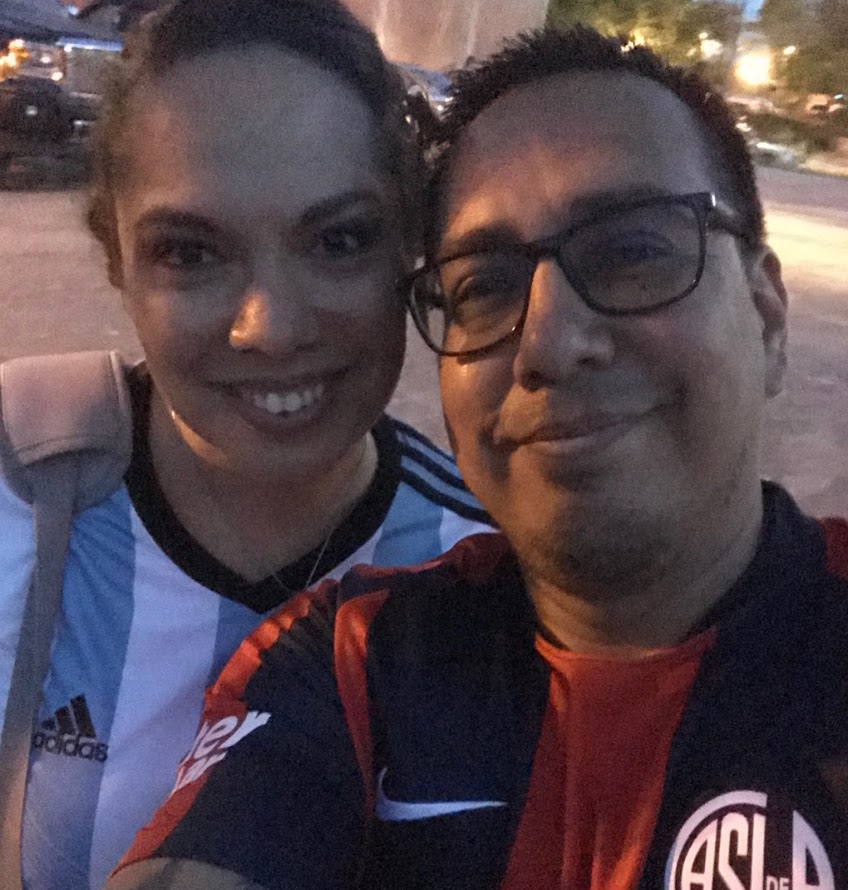
When Argentina scored the first goal, I jumped up and cheered. As I began to sit down, I realized not only that I was outnumbered by the Mexican supporters but also I was getting weird looks and confused faces looking at me. I understand. I am wearing my San Lorenzo jersey, cheering on Argentina, and I look Mexican.
Why don’t I support the Mexican national team (el Tri)? The answer is not short and simple involves my nationality, my ethnicity, where I have lived, and of course football/soccer.
Los Angeles!
I am an American, born and raised in the Los Angeles–the best city in the world. So I should really support the USNMT–right? I don’t, but the reason I will admit is petty. I don’t like the USNMT’s chant–it takes too much work and requires someone to lead in order to get it right. I cheered on the USNMT in the world cup while living in Dallas. That chant, I just can’t. So, I started to follow the Black Stars–Ghana’s national team. They were my team until 2018.
El Tri
I am of Mexican heritage. So I should support el Tri, right? I tried. I cheered them on in the 1994 world cup–the Mexico vs Ireland was a fun match. Mexico had a great squad under Ricardo La Volpe. The squad played fast and deployed a great offense. I was proud supporter. I owned the jerseys, and went to every match they had in LA.
I was so disappointed when el Tri let La Volpe go. Rumor has it that he was let go because he was Argentine, and how dare Mexico not have a Mexican coach. I wasn’t impressed with the results. I tried to hold and and get excited but I couldn’t. I jumped ship to the Black Stars.
The Black Stars did not disappoint. They played well and made it to the cup. They would have advanced in the cup if it wasn’t for Suarez’ handball in 2010. I stuck with Ghana.
Argentina
in 2018 I moved to Buenos Aires, Argentina and lucky for me it was a world cup year. I loved experiencing the world cup in a country the loves football/soccer–it was amazing. Before moving to Argentina, I was warned about the snobby Argentinians that would treat me bad because of Mexican heritage. I did not know what to expect when I moved there.
When I walked off the plane in Ezeiza, the sudden realization that I was no longer in the U.S. hit me. The feeling was overwhelming. I can read, write, and speak Spanish, but everything is in Spanish in Argentina and for a second I questioned whether or not I can live in an all Spanish world. Well, take a deep breath and suck it up Marine.
In Argentina, the people welcomed me. They were friendly and kind. Some could tell I was a Yankee, but most thought I was a Mexican national. I tried to attend a River Plate or Boca Jr match, but I had no luck. I was invited to San Lorenzo matches and I loved it. I was later told that most Americans my team knew supported San Lorenzo. They assumed it was the team colors–red, white, blue. Argentina’s national team is my team. Why? Because I’ve lived there, I been to a Superliga match, I’ve watched the world cup in Argentina, and the people accepted me.
I could go on about culture, and how it is a human construct–I won’t. Oh, the final score was ARG 4 – 0 MEX.




















 Isidro V. Reyes